

Your Work Boots Decide What the Job Takes From Your Body
Most people think work boots protect toes. That is true, but it is incomplete.
Work boots influence how force moves through your body. Every step on concrete, gravel, ladders, and steel floors sends energy upward. Your boots decide how much of that energy your feet absorb and how much gets passed to your knees, hips, and lower back.
Over years of work, that difference adds up. Fatigue becomes normal. Joint pain becomes expected. People accept it as part of the job, even when it does not have to be.
This is not about comfort in the showroom. It is about how your body holds up after thousands of hours on the job.
Work Boots Are Load-Bearing Equipment

A worker can stand, walk, climb, and carry because their boots manage load.
Every shift involves:
- Repeated impact with hard surfaces
- Uneven footing
- Sudden weight transfer
- Long periods of standing still
If a boot lacks structure, that load goes somewhere else. Usually into soft tissue and joints that were never designed to take it repeatedly.
This is why two workers in the same role can age very differently. One replaces boots before they collapse. The other works through worn footwear and pays for it later.
Work related musculoskeletal disorders are a major category of workplace injury that can lead to pain, disability, and lost work time in Canada, and factors like poor footwear fit and support can contribute to discomfort or ergonomic strain on the feet and legs.
Protection Is More Than a Toe Cap
Safety certifications matter. In Canada, CSA Z195-14 sets requirements for impact protection, puncture resistance, and electrical hazard protection. ASTM F2413-24 covers similar ground in the United States.
Certification confirms that a boot can stop a defined hazard under test conditions.
What certification does not measure is:
- How evenly pressure spreads under your foot
- How well the boot controls motion during fatigue
- How the boot behaves after months of wear
A boot can pass every lab test and still leave a worker exhausted at the end of the day if its structure breaks down early.
Think of certification as permission to enter the jobsite. Performance is what keeps you functional long term.
Fatigue Is a Safety Issue, Not a Comfort Complaint
Fatigue changes how people move. When legs are tired, steps get sloppy. Balance reactions slow. Small hazards turn into injuries.
Boot weight, midsole response, and overall stability directly affect fatigue levels. A heavier boot demands more energy every time you lift your foot. A dead midsole forces muscles to absorb impact instead of the boot doing its job.
Over time, fatigue compounds. Workers adapt by changing posture or gait. That adaptation creates new stress points.
Reducing fatigue is not about softness. It is about efficient energy management.
Fit Is Structural, Not Personal Preference
Many people say fit is subjective. That is only partly true.
Certain fit problems are structural failures:
- Heel lift causes friction and instability
- A narrow toe box restricts natural foot spread
- Collapsing uppers allow uncontrolled movement
A boot should hold the foot in place without squeezing it. Stability should come from structure, not tightness.
Trying boots at the end of the day matters because feet swell under load. That swelling is part of real work conditions, not an inconvenience.
Learn more: Complete Work Boot Buying Guide
Outsoles Decide How Confident You Move

Confidence changes movement. Workers who trust their footing move naturally. Workers who do not hesitate, brace, and tense up.
Outsole design influences:
- Traction on wet or dusty surfaces
- Stability during lateral movement
- Control when stepping down ladders
An outsole built for outdoor terrain may feel unpredictable indoors. Smooth warehouse floors require different rubber behaviour than rough ground.
Choosing the wrong outsole forces your body to compensate. Compensation increases strain.
Durability Protects More Than Your Wallet
Boots rarely fail all at once. They fail gradually.
Common failure points:
- Midsoles that compress and never rebound
- Stitching that loosens under repeated flex
- Leather that thins and loses shape
Once structure is gone, the boot still looks usable. Many workers keep wearing it. At that point, the boot becomes a liability.
Replacing boots earlier costs less than dealing with chronic pain or missed work.
Learn more: 5 Signs To Replace Your Work Boots
Why Lightweight Construction Matters

Heavy boots were once the price of protection. That trade-off is no longer necessary.
Modern work boots use:
- Composite toe caps instead of steel
- Advanced puncture resistant plates
- Rubber compounds designed for durability without excess mass
Reducing boot weight lowers energy expenditure across a shift. Over thousands of steps, that difference is measurable.
Lighter does not mean weaker. It means smarter material use.
Where MooseLog Comes In
MooseLog builds work boots with the assumption that workers are professionals, not disposable labour.
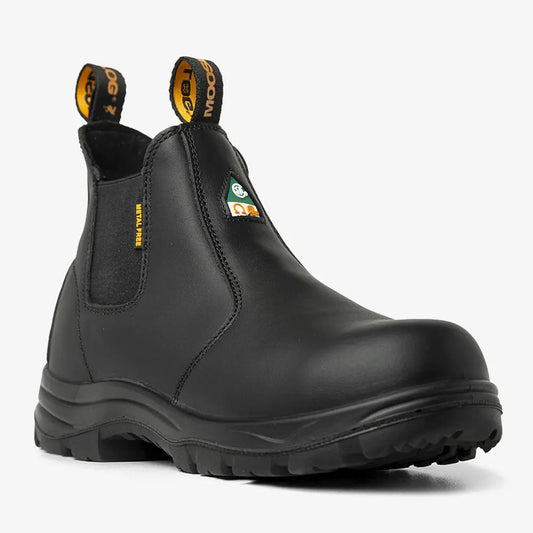
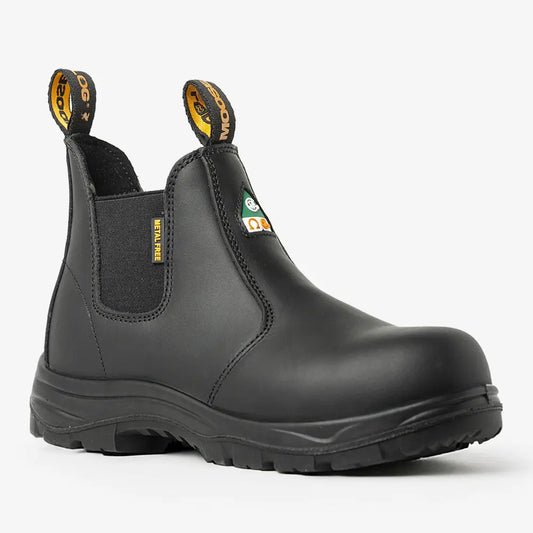
Every MooseLog safety boot meets CSA Z195 and ASTM F2413 standards. Beyond certification, the focus is on structure, controlled flexibility, and long-term wear stability.
Composite toe protection reduces weight. Dyna-Flex® puncture resistant plates provide underfoot protection without rigidity. SafeTread™ rubber outsoles are designed for real jobsite movement, not showroom floors.
The goal is straightforward. MooseLog work boots protect your feet while reducing how much the job takes from the rest of your body.
Conclusion
Work will always take something from you. That is reality.
What matters is how much it takes and how early it starts.
Work boots are not accessories. They are load-bearing equipment that shape how your body handles years of labour. Choosing well protects more than your toes. It protects your ability to keep working without unnecessary pain.