

Best HVAC Work Boots for Technicians 2026 | CSA & ASTM Compliant
HVAC service is a movement-heavy trade. You move between rooftops, ladders, mechanical rooms, and finished interiors. You climb more than you walk. You kneel in tight spaces, balance on rungs, and step across concrete, tile, metal grating, and roof membranes in the same shift. Few trades put boots through that many transitions in a single day.
Most work boots are not built for that pattern.
Many are designed for forward motion on rough ground. Others are built to stand still under load. HVAC service work sits somewhere else entirely. It is lateral, vertical, repetitive, and precise. When a boot is built for a different trade, that mismatch shows up fast.
In Canada, that difference still has to live inside CSA jobsite requirements. Whether you are on a commercial rooftop, inside a mechanical room, or working through finished residential spaces, your boots must meet safety standards without becoming a liability to how you move.
The goal here is simple. Identify what actually matters for HVAC service work in 2026, and filter out the features that sound tough but work against you on ladders, rooftops, and long service days.
Why Most “Good” Work Boots Fail HVAC Technicians
Boots designed for general construction assume forward motion on rough ground. HVAC service work is lateral, vertical, and repetitive.
Heavy boots feel stable on day one. Two weeks later, your feet feel slow on ladders. Thick outsoles feel protective until you are balancing on narrow rungs. Aggressive tread grips mud well and feels wrong on smooth mechanical room floors.
These are not defects. They are design choices made for other trades.
HVAC Service Work Rewards Precision, Not Mass

Good HVAC boots feel boring when you pick them up. That is usually a good sign.
What matters more than toughness:
- predictable footing on ladders
- controlled heel shape
- forefoot flexibility for kneeling
- traction that behaves indoors
- protection that meets site rules without excess material
If a boot feels like it is “doing a lot,” it is probably doing the wrong things.
Safety Toe Reality for HVAC Techs
Most experienced HVAC technicians already know this, but it is worth stating clearly.
Composite toe makes more sense for HVAC service work than steel in most cases.
Not because it is trendy. Because it:
- weighs less over constant movement
- avoids temperature transfer on rooftops
- works better around electrical equipment
- meets CSA and ASTM requirements without bulk
Steel toe still has a place on certain industrial sites. For daily service work, composite usually fits the job better.
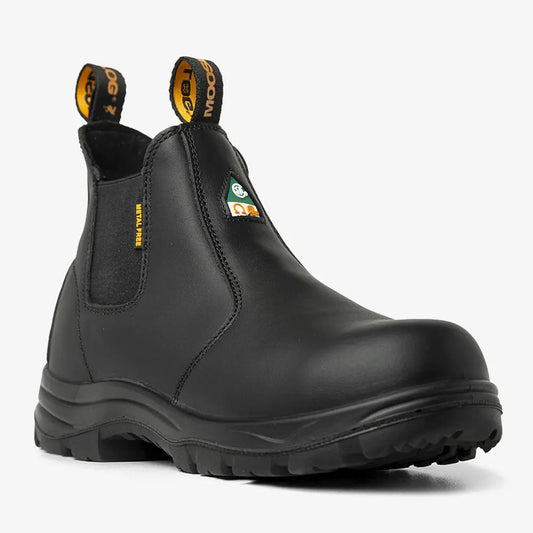
MooseLog Timber: For HVAC Service Techs Who Move All Day

MooseLog Timber is built for technicians who spend most of their time in motion, not standing in one place.
Where it fits HVAC service work:
- composite toe keeps weight down
- controlled outsole behaves well indoors
- stable heel for ladder work
- flex where HVAC techs actually need it
Timber works for technicians who are in and out of buildings, on and off ladders, and tired of boots that feel overbuilt for what they do.
The Vibe: You’ll forget you’re even wearing them.
Best For: Residential service, light commercial, and anyone who values agility over bulkiness.
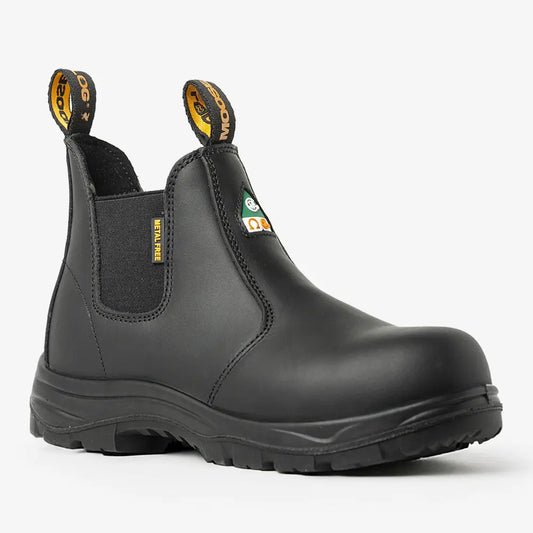
MooseLog McCoy: For Techs Splitting Service and Heavier Commercial Work

Some HVAC technicians split time between service calls and heavier commercial or light industrial work. That changes the equation slightly.
MooseLog McCoy adds structure without turning into a brick.
Why it fits that middle ground:
- composite toe with a more planted feel
- outsole that handles rougher surfaces better
- stable platform for long concrete days
- still compliant without unnecessary weight
McCoy fits technicians who want more underfoot confidence without going full construction boot.
Other Conditions Worth Accounting For
Most HVAC service work happens in mixed conditions. That’s where balanced, lightweight work boots earn their keep.
But there are situations where different priorities matter more.
In winter service work, especially on rooftops or outdoor callouts, insulation becomes critical. Boots with 3M Thinsulate™ or equivalent thermal lining help retain heat during long exposure to cold metal and wind. Without insulation, even the best general-purpose work boot becomes a liability.
In wet or slushy conditions, waterproof construction and sealed seams matter more than breathability. Snow melt, rooftop ice, and soaked concrete will find their way into poorly sealed boots fast.
Some technicians also prefer taller boots or added ankle structure when working on uneven industrial surfaces for extended periods. Others prioritize lighter footwear when most of the day is spent indoors.
There’s no single “HVAC boot.” There are only trade-offs based on where and how you work.
Final Word for HVAC Techs in 2026
If your boots feel fine but slow you down, they are wrong for HVAC work.
Good HVAC boots disappear during the day. They stay predictable on ladders. They do not fight your movement. They meet site requirements without announcing themselves.
That is what experienced technicians end up valuing.
View MooseLog CSA Approved Safety Shoes built for technicians who value control, consistency, and jobsite compliance.