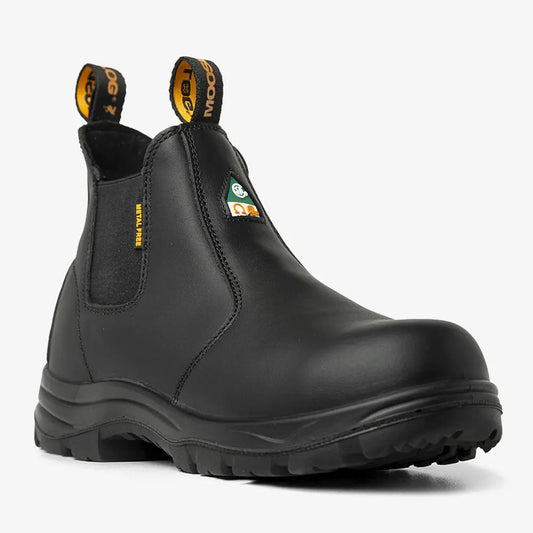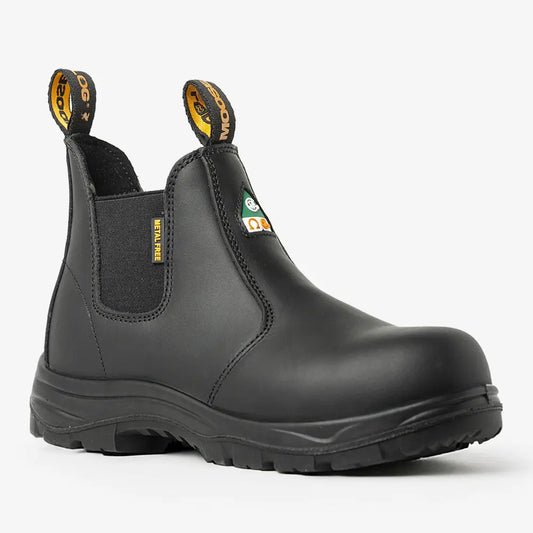


How Long Do ASTM F2413 Boots Stay Compliant?
Most workers assume that once a pair of safety boots is certified, they're covered for as long as they're wearing them. You bought the right thing, it passed the test, job done.
That's only true on day one.
Everything after that comes down to what you actually put those boots through.
ASTM F2413 certification is based on testing brand-new boots — clean, factory-fresh, structurally intact. The stamp reflects that one moment in time. Not halfway through a season on gravel. Not after eight months on a concrete floor.
So the better question isn't how long your boots last. It's whether they still perform like the boots that passed the test.
The Certification Doesn't Expire — But Your Boots Do Change

There's no expiry date on safety boots. No alert, no warning light, nothing.
But leather softens. Soles wear down. Internal components take repeated stress over months. It happens slowly enough that most people don't notice until something feels off — the grip isn't quite there, the support feels different, you start adjusting your footing without really thinking about why.
The label still says certified. The boot is not the same boot.
This is exactly why build quality matters from day one. A boot that starts with a solid, well-constructed foundation — like the MooseLog Timber or the McCoy & MacGill — holds its structure longer under daily punishment than something that was only ever built to look the part on a shelf.
What Goes First
Most workers assume it's the toe cap. Makes sense — that's where impact and compression ratings live. But unless you take a direct hit, the toe cap usually holds up longer than people expect.
What typically degrades first is traction.
The outsole wears down gradually. The tread smooths out. You lose that grip on wet concrete, dusty platforms, packed dirt. It doesn't announce itself — you just notice one day that you adjusted your footing on a surface you never used to think twice about.
The boot hasn't technically "failed." But it's no longer doing what it did when it was tested.
The Changes You Can't See
The visible wear is only part of the story.
Inside the boot, the midsole compresses over time. Support shifts. If there's a puncture-resistant plate, it's flexing with every step, especially on uneven ground. None of that is something you can eyeball from the outside.
You're working off feel. And when the inside changes, the protection the boot was certified for becomes less predictable.
The same goes for electrical hazard ratings. EH protection depends on materials staying intact — once the outsole starts cracking or moisture finds a way in, you can't just assume that layer of protection is still doing its job.
So How Long Do They Actually Stay Compliant?

No fixed number, but the answer isn't complicated.
Indoor work on clean, consistent surfaces? The boots hold up longer. You're not grinding them down the same way.
Rough outdoor sites, debris, climbing, wet conditions, long days on your feet? Everything degrades faster. Not because the boots are cheap — just because that's what the work demands.
A boot can look passable from the outside and already be past the point where it performs like a compliant safety boot. That gap between appearance and actual performance is where people get caught out.
What helps close that gap is a boot that was genuinely built for daily use — not just certified for it. The MooseLog Timber, McCoy & MacGill are dual-certified to both ASTM F2413 and CSA standards, which means they're cleared for most Canadian and American jobsites without any second-guessing. But more than that, they're designed to be your everyday pair. Lightweight and comfortable enough that you actually want to wear them, durable enough that throwing them into real work every day is exactly what they're made for.
What Gets You Flagged on Site
Nobody on site is pulling out your certification paperwork.
They're looking at your boots.
Flattened soles, visible cracking, collapsed structure — that's usually enough to raise a flag, regardless of what the label says. Supervisors care about whether your gear looks capable of doing its job. If it doesn't, you're getting a conversation at minimum, or you're off site.
Dual ASTM and CSA certification takes the compliance question off the table entirely — whether you're crossing the border for a job or working across both markets, you're not scrambling to check if your boots qualify.
Why It's Worth Paying Attention
Stretching a pair of boots longer than you should is completely understandable. They're expensive. If they're still wearable, you keep wearing them.
But certified safety boots aren't just footwear — they're rated protection. Once that rating starts to slip, even gradually, you're taking on more risk than you realize. Not dramatically, not all at once, but enough to matter if something goes wrong.
The other side of that is simple: when a boot is genuinely comfortable and doesn't feel like a chore to put on every morning, you're more likely to replace it when it's actually time — instead of grinding it down to nothing because breaking in a new pair sounds like a hassle.
The Bottom Line
ASTM F2413 boots are certified new. After that, every shift changes them a little.
When the structure goes, the performance goes with it. At some point, the label on your boot stops matching what the boot can actually do. That's when it's time for a new pair — not when they fall apart, but before the gap gets too wide.
If you're due for a replacement, the MooseLog Timber and the McCoy & MacGill are worth a look. Dual ASTM and CSA certified, built light enough to wear all day, and tough enough to actually earn it.