

Règles de l'OSHA concernant les chaussures : ce que les travailleurs doivent savoir (mise à jour 2026)
Chaque année, des milliers de travailleurs sont mis à l'arrêt à cause de blessures aux pieds ou reçoivent des contraventions. Pourquoi ? Ils portent des chaussures de sécurité inadaptées ou n'en portent pas du tout. Si vous avez des questions sur les exigences de l'OSHA, nous sommes là aujourd'hui pour vous expliquer en détail ce que dit la loi concernant les chaussures de protection : qui prend en charge les coûts, comment vérifier la conformité de vos chaussures et les nouveautés pour 2025.
Quelles sont les exigences de l'OSHA en matière de chaussures de sécurité ?
La réglementation de l'OSHA relative à la protection des pieds ( 29 CFR 1910.136 ) est claire : si votre travail comporte des risques de chute d'objets, de manipulation d'objets tranchants ou d'électrocution, vous devez porter des chaussures de sécurité. Sans exception. Cependant, l'OSHA n'appose pas d'étiquette « homologué » sur les marques. Elle renvoie plutôt à la norme ASTM F2413, relative aux chaussures de sécurité.
Voici le résumé :
- Des dangers sont présents ? Vous avez besoin de bottes de sécurité.
- Rôle de l'employeur : s'assurer que vous les portez.
- Conformité : Les bottes doivent réussir les tests ASTM.
L'OSHA exige-t-elle que les employeurs paient pour les bottes de travail ?
L'OSHA stipule que les employeurs doivent prendre en charge les équipements de protection individuelle (EPI) spécialisés (comme les protections métatarsiennes ou les bottes de sécurité contre les risques électriques). Mais qu'en est-il des bottes de sécurité ordinaires que vous pouvez porter hors du lieu de travail ? Elles sont généralement à votre charge. Consultez la politique de votre entreprise ou la convention collective. Si ce sont des bottes spécifiques (par exemple : pas des bottes de sécurité à embout d'acier classiques), votre employeur les prend probablement en charge.
Que signifie ASTM dans le domaine des bottes ?
La norme ASTM F2413 est la norme de référence. Elle permet de tester :
- Impact (I/75) : Survit à des chutes de 75 pi-lb.
- Compression (C/75) : Supporte 2 500 lb de compression.
- Résistance à la perforation (PR) : Arrête les clous et les objets pointus.
- Risque électrique (EH) ou dissipation statique (SD) : vous protège des chocs électriques.
- Protection métatarsienne (MT) : Protège le dessus de votre pied.
Recherchez une étiquette à l'intérieur de la languette ou de la doublure de la botte, comme : ASTM F2413-18 MI/75 C/75 PR EH . C'est la preuve de son authenticité.

Comment savoir si des chaussures sont homologuées OSHA ?
Pas d'étiquette ASTM F2413 ? Non conforme. Voici votre liste de vérification :
- Vérifiez l'étiquette : « Conforme à la norme ASTM F2413 » plus les codes de protection.
- Lisez attentivement les mentions légales : les descriptions des produits doivent confirmer leur conformité aux normes ASTM.
- Adaptez-les à votre travail : assurez-vous que les caractéristiques de la botte (embout, semelle, protection contre les surtensions) correspondent à vos risques.
- Faites confiance à la source : les marques réputées partagent leurs données de test.
S'il lui manque ces éléments, n'y mettez pas les pieds.
Les bottes à embout composite sont-elles approuvées par l'OSHA ?
Oui, si elles sont conformes à la norme ASTM F2413. L'OSHA est impartiale : les bottes à embout composite (fibre de verre, fibre de carbone, Kevlar) sont tout aussi conformes que les bottes à embout d'acier si elles répondent à la norme ASTM F2413. Les matériaux composites sont plus légers et ne conduisent ni la chaleur ni l'électricité, ce qui est un avantage pour les électriciens ou les chantiers exposés au froid. Choisissez celles qui conviennent le mieux à votre travail.
Les chaussures de sécurité sont-elles obligatoires dans les entrepôts ?
Si votre entrepôt comporte des chariots élévateurs, des palettes lourdes ou des débris tranchants, l'OSHA exige le port de chaussures de sécurité. Même pour des environnements moins chargés, le port de semelles antidérapantes ou anti-perforation est fortement recommandé. Votre employeur évalue les risques, mais la norme 29 CFR 1910.136 s'applique : dangers = port de chaussures.

Votre liste de contrôle des bottes OSHA
Avant de pointer, exécutez ceci :
- L'étiquette indique « Conforme à la norme ASTM F2413 »
- Protection des orteils (I/75 C/75) visible
- Les fonctionnalités correspondent à votre poste (PR, EH, SD, MT)
- Les bottes ne présentent ni fissures ni semelles usées.
- Renseignez-vous sur la politique de votre employeur concernant la prise en charge des frais.
Tout est en ordre ? Vous êtes prêt pour les inspections et votre travail est en sécurité.
Mises à jour 2026 : Règles de l’OSHA concernant les chaussures de sécurité
La norme de base de l'OSHA concernant les chaussures ( 29 CFR 1910.136 ) n'a pas changé à l'approche de 2026, mais voici ce qui compte réellement pour les agents de sécurité sur le terrain :
Les coûts de la sécurité à la loupe :
L'OSHA considère désormais explicitement la prévention des accidents du travail comme un risque pour les entreprises. Selon des mises à jour récentes de l'agence, les employeurs versent plus d'un milliard de dollars par semaine en indemnités directes pour accidents du travail, tandis que le coût total des accidents et décès au travail s'élève à près de 1 200 milliards de dollars à l'échelle nationale . Les blessures aux pieds demeurent parmi les incidents les plus fréquemment déclarés, ce qui incite à examiner de plus près le choix des chaussures lors des audits.
La documentation est plus importante que jamais :
Plutôt que d'introduire de nouvelles règles techniques concernant les chaussures de sécurité, l'OSHA privilégie l'analyse des rapports d'accidents et des évaluations des risques . Avec l'affichage obligatoire de la section 300A et les déclarations ITA , les blessures aux pieds répétées ou évitables soulèvent immédiatement des questions quant au choix de chaussures de protection adaptées au poste de travail.
La conformité proactive est attendue :
L’OSHA continue de promouvoir son programme de consultation sur site , utilisé par plus de 21 000 employeurs l’an dernier. Bien que facultatifs, ces programmes témoignent d’une exigence claire : les employeurs doivent évaluer les risques, choisir les EPI appropriés et documenter leurs décisions avant que des accidents ne surviennent, et non après.
Ces tendances renforcent les principes fondamentaux : identifier les dangers au plus tôt, adapter les chaussures de sécurité certifiées aux risques réels sur le lieu de travail et tenir une documentation rigoureuse afin d’éviter les temps d’arrêt, les amendes ou les incidents répétés coûteux.
En résumé
Les règles de l'OSHA sont simples : trouvez des bottes portant l'étiquette ASTM F2413, adaptées aux risques liés à votre travail, et le tour est joué. Ne vous laissez pas influencer par le marketing ou les arguments de marque, mais concentrez-vous sur les spécifications. Pour notre équipe canadienne, La norme CSA Z195 suit les mêmes normes d'essai, donc une seule paire certifiée vous assure une protection des deux côtés de la frontière.
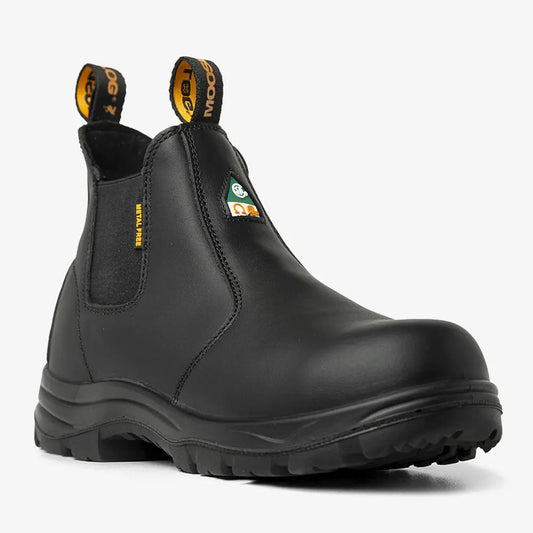
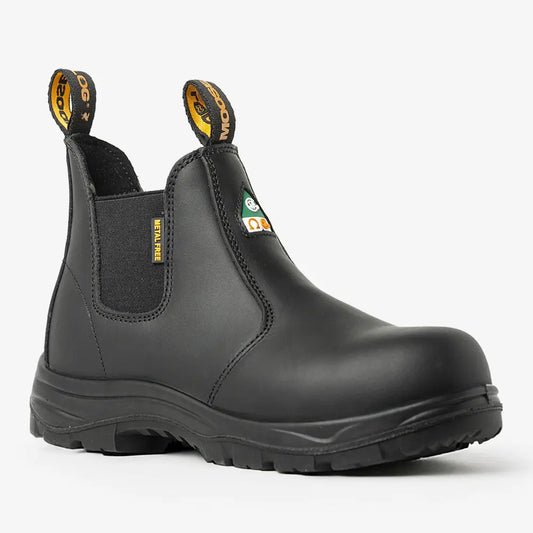
Chez MooseLog, chaque botte répond à ces exigences . Testées, certifiées et prêtes pour le travail que vous effectuez.